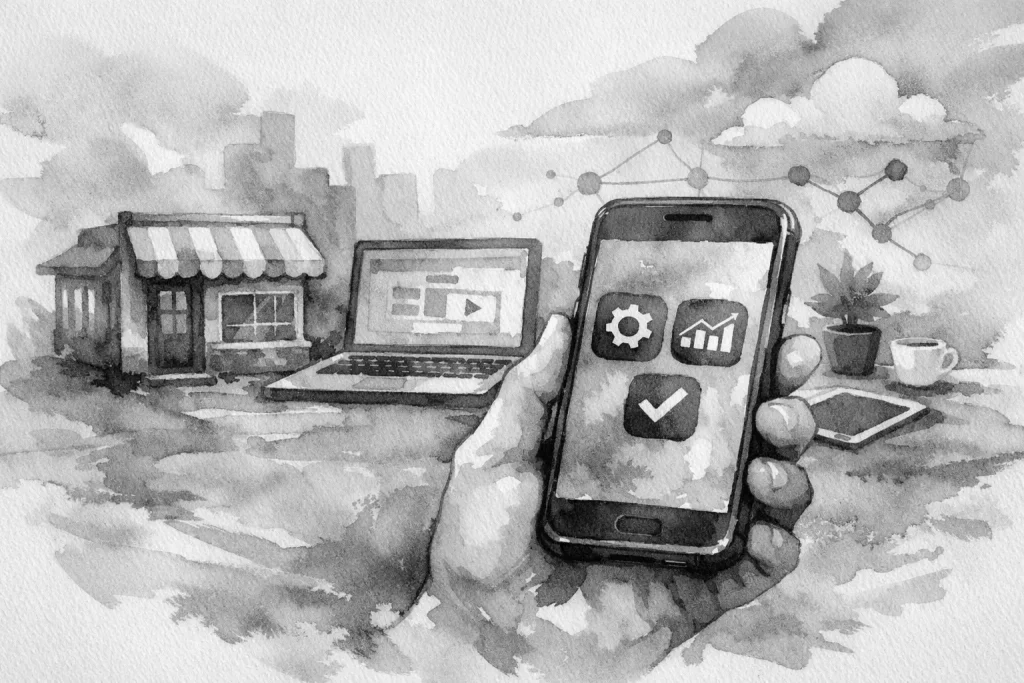
Most small businesses do not need a flashy app. They need fewer manual steps, fewer dropped leads, and less time spent moving information between inboxes, spreadsheets, and staff. That is where small business app development services actually matter – not as a trend, but as a practical way to make the business run cleaner.
For a local service company, a medical practice, a contractor, or a multi-location operator, the right app is often not a public app store product at all. It might be a custom quoting tool, a lead routing workflow, an internal dashboard, a service request form tied to notifications, or a customer portal that cuts down on phone calls. Good app work starts with the operation, not the interface.
What small business app development services should actually solve
A lot of business owners hear “app development” and picture a large, expensive software project. That can happen, but it is usually the wrong starting point. For most small businesses, the better question is simpler: where is work getting stuck?
If leads come in through the website but sit too long before follow-up, that is a system problem. If staff re-enter the same customer information in three places, that is a system problem. If reporting depends on one person pulling numbers manually every Friday, that is a system problem. Small business app development services should be aimed at those friction points.
That means the best project is often narrow at first. Instead of trying to rebuild the whole business in software, you focus on one workflow that saves time, improves response speed, or reduces mistakes. A dispatch form for a field team. A service intake app for office staff. A custom dashboard that shows open jobs, pending invoices, and follow-up status in one place. Those are practical wins.
Custom app or off-the-shelf tool?
This is where some restraint helps. Not every problem needs a custom-built app. In many cases, an off-the-shelf platform with the right setup is enough. If your needs are standard, your process is simple, and your team can work within a tool’s limits, buying software may be the better business decision.
Custom development makes more sense when your workflow is specific, your team is working around tool limitations, or you are paying for multiple disconnected systems that still do not fit the way the business operates. It also makes sense when the handoff between your website, internal processes, and customer communication needs to be tighter than a generic product can offer.
The trade-off is straightforward. Off-the-shelf tools are usually faster to adopt and cheaper upfront, but they can create workarounds that cost time every week. Custom apps fit better and can support cleaner operations, but they require better planning and clearer priorities. The right answer depends on how central the process is to your business and how much inefficiency is already costing you.
Where custom apps create the most value
For small businesses, app development tends to pay off most when it supports recurring work. If a task happens daily or weekly, even modest time savings add up fast.
Lead handling is a common example. A business may have a solid website and decent traffic, but the intake process is messy. Forms go to email, emails get forwarded, follow-ups are inconsistent, and no one has a clean view of lead status. A custom intake and routing system can tighten that process immediately.
Scheduling and field operations are another strong use case. If your staff is coordinating jobs, visits, estimates, or deliveries, a lightweight app can centralize assignments, notes, status updates, and customer details. That reduces phone tag and cuts down on missed information.
Internal reporting is often overlooked, but it matters. Many owners are making decisions from fragmented numbers across accounting software, spreadsheets, call logs, and website leads. A custom dashboard does not need to be fancy to be useful. It just needs to put the right information in one place so managers can act on it.
Customer-facing tools can also be worthwhile, but only when they solve a real business problem. A portal for document collection, order updates, appointment requests, or service history may improve the customer experience while reducing admin work. A public app with little ongoing use usually does not.
What to look for in small business app development services
A good provider should talk about workflows before features. If the first conversation is all screens, design trends, and technology choices, that is usually a sign the project is being framed backwards. The business process comes first.
You want a partner who can map how work currently moves through the business, identify friction, and suggest the smallest effective solution. That might involve a custom app, but it could also involve automation, better forms, cleaner data flow, or tighter integration with your website.
This is especially important for local businesses that cannot afford disconnected digital projects. Your website, forms, search visibility, staff workflows, and reporting should support each other. When those pieces are treated separately, owners end up with more tools but not better operations.
A practical provider should also be clear about support. Apps are not one-time assets that sit untouched forever. Staff changes, processes change, and the business changes. You need someone who thinks in terms of maintenance, iteration, and improvement, not just launch day.
Why website and app strategy should be connected
For many small businesses, the website is the front door and the app is the back office. If those systems are disconnected, friction shows up fast.
A lead form that does not feed the right internal process creates delays. A quote request page without structured intake fields leaves staff chasing details later. A customer portal that is hard to access or poorly tied to the website creates support issues instead of reducing them.
This is why app development should not live in a silo. If the same partner understands your website, local visibility, internal workflows, and operational needs, the result is usually more practical. Erie Digital Co. works this way because local businesses rarely need isolated digital projects. They need systems that fit together and improve the day-to-day.
Common mistakes business owners make
The biggest mistake is starting too big. When owners try to build an all-in-one platform from the start, projects get expensive, slow, and hard to manage. A focused first phase is almost always better.
Another mistake is building around assumptions instead of actual staff behavior. If the office team still uses text messages, paper notes, or side spreadsheets because the process is awkward, the problem is not employee resistance. The system probably does not match the real workflow.
It is also easy to overvalue features and undervalue adoption. A simple tool that your team uses consistently is worth more than a complex one that looks impressive in a demo. Usability matters, especially for busy staff who do not have time for extra steps.
Finally, some businesses treat the app as separate from operations. That leads to weak ownership, unclear processes, and software that no one maintains. The app should support how the business runs. It should not become another thing the business has to work around.
A practical way to approach app development
Start with one recurring pain point that costs time, creates delays, or causes mistakes. Map the current process clearly. Identify what information is needed, who uses it, where it gets stuck, and what a better flow would look like.
From there, define success in plain business terms. Faster response time. Fewer manual entries. Better visibility across locations. Cleaner handoffs between office and field. If success cannot be described operationally, the project is probably still too vague.
Then build the smallest version that solves the core problem. That gives the team something useful sooner and creates a better basis for future improvements. Once the process is working, additional features become easier to justify.
That approach is usually better for budget control, staff adoption, and long-term usefulness. It also fits how most small businesses actually grow their systems – step by step, based on what the operation needs next.
Small business app development services are most useful when they help a company look sharper and work smarter at the same time. If the project reduces friction, supports your team, and fits how the business really operates, it is doing its job. Start there, and the technology stays practical instead of becoming another layer of complexity.