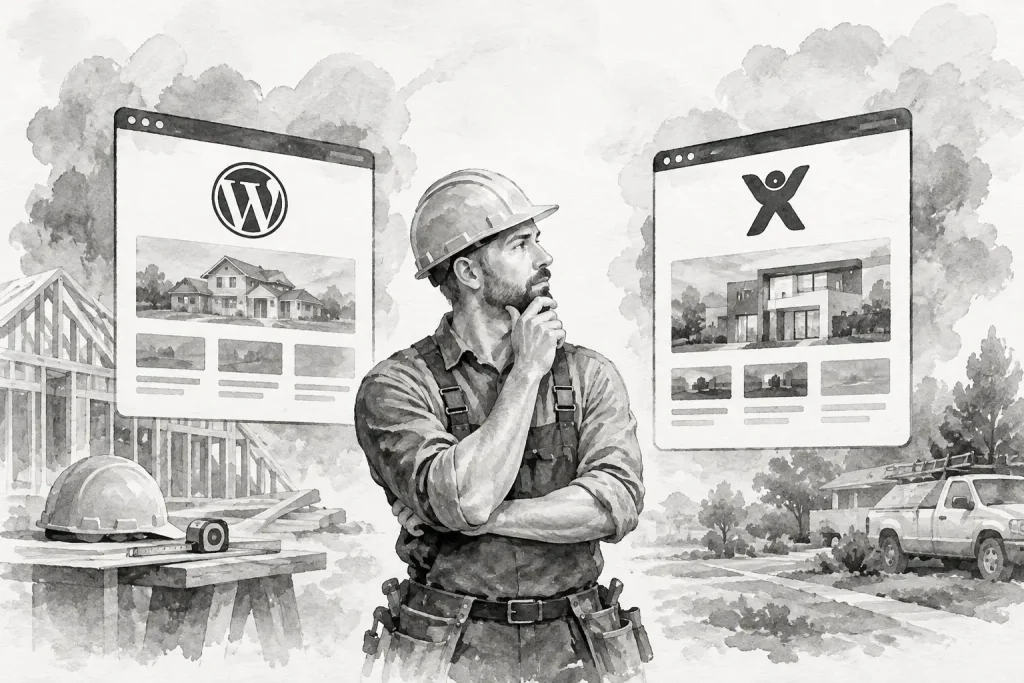
A contractor’s website has a short window to do its job. A homeowner searching after work wants to see the right service, proof that you serve their area, a way to contact you, and a reason to trust you. The WordPress versus Wix for contractors decision matters because the platform affects how easily that path can be built, maintained, and improved as the business grows.
A website builder can get a small operation online quickly. That is useful when the immediate need is a clean brochure site. But contractors rarely stay static. Service areas expand, crews add specialties, estimate requests need better routing, and local search visibility becomes more valuable. The better choice depends less on which platform looks easier on day one and more on what the site needs to support over the next few years.
WordPress versus Wix for contractors: the practical difference
Wix is a hosted website builder. Its appeal is straightforward: a business owner can select a template, arrange pages visually, publish, and handle many basics within one controlled system. There is less technical setup at the start, and routine platform maintenance is largely handled behind the scenes.
WordPress is a content management system with far more implementation options. It can be built as a simple marketing site, but it also supports custom page structures, integrations, lead workflows, service-area content, and specialized functionality. That flexibility requires better planning and ongoing care. It is not automatically the right answer simply because it has more capability.
For a contractor, the decision usually comes down to control versus convenience. Wix reduces the amount of technical administration. WordPress gives a business more room to shape the website around how its sales process and operations actually work.
Start with the work your website must do
Before comparing templates, define the website’s job. A painter with one crew and a defined service radius may only need service pages, project photos, reviews, a contact form, and clear calls to request an estimate. A growing HVAC, electrical, restoration, or remodeling company may need location pages, separate conversion paths for emergency work and planned projects, financing information, quote qualification, recruiting, and connections to internal tools.
If the website is primarily an online business card, Wix can be a sensible fit. It is often enough for a new company that needs to establish credibility quickly and does not expect unusual functionality.
If the site needs to become a lead-generation system, WordPress usually provides the stronger foundation. That does not mean adding every available feature. It means building the pages, forms, tracking, and integrations that reduce friction between a prospective customer and a qualified lead.
A practical question helps clarify the choice: if your office staff had twice as many inquiries next month, would the current website help them process those requests or create more manual cleanup? Platform choice should support the answer.
Local SEO needs structure, not just a homepage
Contractors compete in local search on relevance, clarity, trust, and technical fundamentals. Neither platform guarantees visibility. A polished template does not replace useful service content, accurate business information, strong reviews, or a well-managed local presence.
That said, WordPress is generally better suited to a long-term local SEO program because it gives a business more control over page architecture and technical details. A contractor can build focused pages for core services, towns that are genuinely served, project types, and customer questions. Proper heading structure, internal navigation, page speed work, schema implementation, and conversion tracking can be handled without forcing the business into a narrow template pattern.
Wix has improved its SEO tools and can support the essentials for many local businesses. It is not a poor choice merely because it is a website builder. The limitation appears when the content strategy or technical requirements become more specific. Customizing how a large set of location and service pages works, managing advanced schema, or connecting analytics and lead sources can become less straightforward.
For Erie-area contractors, the local angle is often specific. A customer may search for basement waterproofing in Millcreek, furnace repair in Harborcreek, or a remodeler serving Edinboro. Those searches deserve pages that answer the actual need, not a collection of thin town pages created solely to chase rankings. WordPress makes it easier to build that kind of useful structure at scale, provided the content and implementation are handled carefully.
Forms, calls, and follow-up are where the decision gets real
A website is not finished when it publishes. It needs to collect leads reliably and give the business enough context to respond well. At a minimum, most contractors benefit from forms that capture the requested service, location, preferred contact method, and a brief description of the work.
Wix can manage basic forms and appointment requests well. For a straightforward operation, that may be all that is needed. The trade-off is that as lead handling gets more complex, the available paths can be more constrained.
WordPress can connect forms to email, customer relationship tools, scheduling systems, spreadsheet-based workflows, job intake processes, and custom automations. This is useful when office staff are re-entering the same details, when different service types need different follow-up, or when leads are getting lost between a call, a form submission, and a dispatch process.
More integrations are not automatically better. Every added tool creates another system to manage. The right approach is to map the current workflow first, then improve the parts causing delays or missed information. A good website should make the office more organized, not give the team another dashboard to ignore.
Design flexibility and brand credibility
Both platforms can produce attractive pages. The more relevant question is whether the site looks credible to the people who hire you and whether it presents your work clearly on a phone.
Wix offers a fast visual starting point, but templates can lead to a familiar, interchangeable look. That is not always a problem. For a contractor with limited material and a modest budget, a clean, consistent template is better than an outdated site with broken pages and unclear contact information.
WordPress gives more freedom to create a site around the business rather than around a preset layout. That matters when you want project galleries organized by service, strong proof points near contact forms, service pages built for different customer needs, or a design system that can grow without a redesign every year.
Freedom also creates risk. A poorly built WordPress site can be slow, difficult to update, and cluttered with unnecessary plugins. The platform is only as sound as the implementation. Contractors should not choose WordPress to collect features. They should choose it when a tailored website and cleaner digital operations will create a clear business benefit.
Maintenance, ownership, and support
Wix is simpler from a maintenance perspective because its hosting environment and platform updates are managed for the user. That convenience is meaningful for an owner who wants minimal involvement beyond updating project photos or changing a phone number.
With WordPress, hosting, backups, security updates, plugin compatibility, and performance checks need active attention. Those responsibilities can be managed through a proper website care process, but they should not be ignored. A site that generates leads is business infrastructure, and business infrastructure needs maintenance.
Ownership deserves equal attention. Before selecting either platform, ask who controls the domain, website account, content, analytics, form data, and any connected tools. A business should be able to access its own digital assets and understand what would be required to move or expand the site later. A low-friction launch is useful, but avoid a setup that makes future improvement unnecessarily difficult.
When Wix is the better fit
Wix is a reasonable choice for a newer or smaller contractor that needs a professional site quickly, has limited content needs, and wants the fewest technical decisions. It works best when the site’s role is simple: explain the services, show recent work, establish trust, and make contact easy.
It can also make sense for a business that has no dedicated support partner and does not plan to add significant integrations or content depth in the near term. The key is to recognize the boundary. If business goals change, the site may need more than a template can comfortably support.
When WordPress is the better fit
WordPress is usually the stronger choice for contractors treating the website as a long-term growth asset. It fits businesses that need stronger local SEO foundations, multiple service and location pages, tailored lead forms, integrations, content control, and room for future operational improvements.
It is particularly valuable when the website must work alongside the business instead of sitting beside it. That could mean routing estimate requests by service type, connecting form activity to a sales process, creating clearer reporting, or building a consistent system as the company adds crews and markets.
The best WordPress setup is not necessarily complex. It is purposeful, secure, easy for staff to use, and supported after launch. That is the difference between a custom website and a custom system.
Choose the platform that matches the next stage of your business, not just the easiest first afternoon. A contractor’s website should make it easier for the right customers to choose you and easier for your team to do something useful with the inquiry once it arrives.