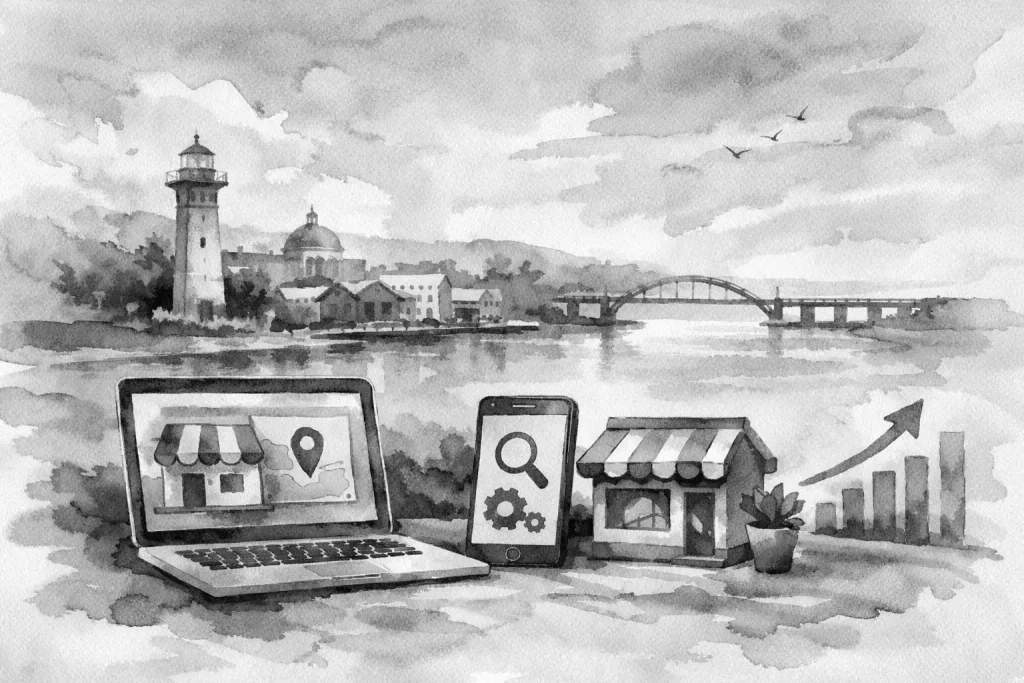
A customer searching for a plumber, contractor, dentist, restaurant, or repair shop in Erie is usually not looking for a marketing campaign. They are looking for a clear answer: who is nearby, open, credible, and able to help. Google Business Profile optimization in Erie puts your business in a stronger position at that moment, when a local search can become a call, direction request, form submission, or visit.
For many local businesses, the profile is one of the most visible parts of their online presence. It can appear before a customer reaches your website, especially on mobile search. That makes it more than a directory listing. It is a working part of your lead-generation system, and it needs the same level of care as your website, phone process, and customer follow-up.
Why Your Google Business Profile Matters Locally
A well-maintained profile reduces friction for potential customers. It confirms what you do, where you serve, how to contact you, and whether other people have had a good experience. When those details are incomplete, outdated, or inconsistent, customers move on quickly. They may also call with basic questions your profile should have already answered.
Local visibility is not only about appearing in a map result. It is about appearing with useful information that supports a decision. Your business category, services, operating hours, photos, reviews, description, and website all help create that picture.
The trade-off is that a profile cannot compensate for a weak business foundation. If your phone goes unanswered, your website is slow, service details are vague, or reviews point to recurring operational problems, adding more profile content will not fix the underlying issue. Good local search work reflects a business that is organized enough to serve the leads it receives.
Start With a Clean, Accurate Foundation
Google Business Profile optimization should begin with accuracy, not posting. First, make sure the business has an owner-managed profile and that access is not tied to a former employee, old agency account, or personal email address that nobody monitors. Ownership and permissions are basic operational controls.
Your business name, phone number, website, address, service area, and hours should match the way the business actually operates. A storefront in Erie needs a precise address and customer-facing hours. A service-area business may need its address handled differently while still showing the communities it serves. The right setup depends on how customers interact with the business, not on what looks most expansive on a map.
Choose Categories With Care
Your primary category is one of the clearest signals you provide about the business. It should describe the core service customers hire you for, not every task your team can perform. Additional categories can add useful context, but only when they are genuinely relevant.
A company that provides several services often benefits from a focused category structure paired with clear service descriptions. Trying to cover every possible search with loosely related categories can create a confusing profile and a confusing customer experience.
Build Services Around Real Customer Language
The services section should reflect the work you want to generate, using terms customers understand. Keep the wording specific. “Commercial electrical repair” is more useful than “quality solutions.” “Kitchen cabinet installation” is more useful than “full-service craftsmanship.”
This is also where your website and profile need to work together. If a service matters enough to feature on the profile, it should have a clear destination on the website with details, proof, and a practical next step. A profile can earn attention. Your website needs to support the decision.
Make the Profile Easier to Trust
A local customer is making a quick judgment based on limited information. Complete details help, but trust also comes from signs that the business is active, legitimate, and responsive.
Photos are part of that work. Use current images of the exterior when customers visit the location, the team when appropriate, completed work, equipment, products, and the environment customers can expect. For service businesses, before-and-after project images can be useful if they accurately represent the work and do not expose private customer information.
Avoid treating photos as a one-time upload. Seasonal changes, new vehicles, completed projects, updated signage, and team additions all give you legitimate reasons to refresh the profile. The goal is not constant activity for its own sake. The goal is a profile that looks like a real, operating business.
Your business description should be plainspoken and useful. Explain what the company does, who it serves, and what makes the process practical for customers. Do not pack it with repeated city names or broad claims that cannot be supported. A clear description earns more confidence than a string of search terms.
Reviews Need a Process, Not a Panic Response
Reviews influence customer confidence and give a business direct feedback about its operations. They should be treated as part of the customer experience, not as a last-minute marketing task when business slows down.
The best review process is simple and consistent. Ask customers after a completed job, successful appointment, purchase, or other positive milestone. Make the request personal, brief, and easy for staff to follow. A business with multiple team members should decide who asks, when they ask, and how the request is recorded so it does not become an afterthought.
Never pressure customers, offer incentives for positive reviews, or ask employees and friends to create feedback that does not reflect a real experience. Those shortcuts can damage trust and create problems that are harder to fix than a slow review count.
Responding to reviews matters as well. Thank customers for specific positive feedback without copying the same response every time. For a critical review, stay professional, acknowledge the concern, and move detailed resolution offline when appropriate. The response is not only for the reviewer. Future customers are watching how the business handles a problem.
Use Updates When They Help the Customer
Posts, updates, offers, and event information can support the profile when they communicate something useful: a new service, seasonal scheduling, holiday hours, a local event, a hiring need, or a timely business update. They are less effective when they repeat generic promotional language every week.
Think of updates as operational communication. A landscaping company can explain when spring estimates open. A restaurant can share a holiday menu change. A contractor can clarify how storm-damage inspections are scheduled. These details answer questions before the phone rings and help customers act with more confidence.
Questions and answers deserve the same attention. Customers may ask about parking, service boundaries, appointment requirements, accessibility, payment methods, or turnaround time. If those questions come up repeatedly, the answer may belong on the profile and the website. Repeated questions are often a sign that information is missing somewhere in the system.
Measure What Happens After Visibility
A profile that receives views but produces no useful action may have a messaging problem, a trust problem, or a website problem. Review the available performance data regularly, including calls, website visits, direction requests, and search activity. Look for patterns over time rather than reacting to a single week.
It also helps to connect these signals to what happens inside the business. Are calls being answered? Are website inquiries reaching the right person? Are customers asking for a service you no longer offer? Are certain service areas producing leads that do not fit your schedule or margins? Local search data is more useful when it informs operations.
Google Business Profile optimization in Erie should be part of a broader local foundation: a fast and clear website, service pages that match actual demand, accurate business information, a review process, and lead handling that does not leave customers waiting. Erie Digital Co. approaches this work as a connected system because visibility has limited value if the next step is messy.
Know When a Cleanup Is Not Enough
Sometimes the profile is not the main issue. If the business has conflicting listings, duplicate profiles, a suspended listing, an outdated website, unclear service positioning, or a lead process built around voicemail and scattered inboxes, the work may require a wider audit.
That is not a reason to delay improvements. It is a reason to prioritize them correctly. Fix the details that create immediate confusion, then address the systems causing that confusion to return. A cleaner profile is useful, but a cleaner digital operation is what keeps local visibility from becoming wasted effort.
The right goal is not to make your listing look busy. It is to make it easier for the right local customer to understand your business, trust the next step, and contact a team that is ready to respond.