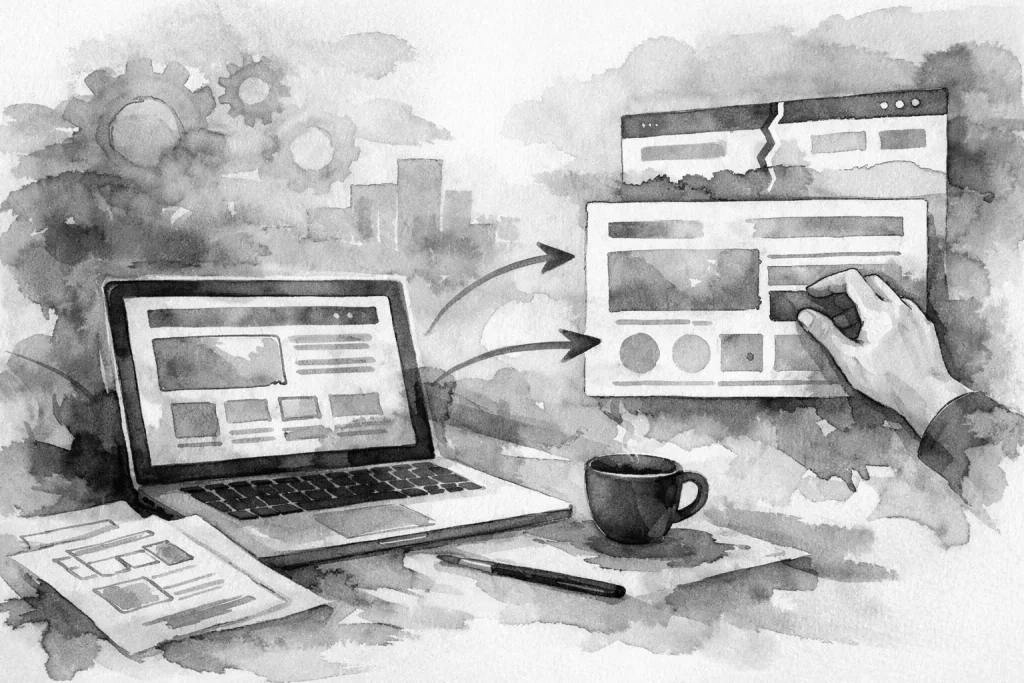
A website redesign strategy should begin with the work your current site is failing to do. For a local business, that is rarely just a visual problem. The site may be slow on mobile, unclear about services, difficult to update, weak in local search, or disconnected from the forms and follow-up processes your team uses every day.
A new look can be part of the answer. It should not be the whole plan. The better goal is to build a website that helps customers find the right information, take the next step, and enter a cleaner internal process once they do.
Start With Business Friction, Not Design Preferences
Before choosing colors, reviewing layouts, or discussing homepage trends, identify where the current website creates friction. Talk to the people who answer calls, respond to web inquiries, schedule work, prepare estimates, and handle customer questions. They usually know where the gaps are.
You may find that prospects regularly call because the service pages do not explain what is included. Maybe contact forms produce incomplete requests that require several follow-up emails. Perhaps different locations, service areas, or business hours are hard to locate. These are operational problems with a website component, not just content problems.
A useful redesign starts with a short audit of what is happening now. Review site traffic and search performance, but also review the practical path a lead takes after submitting a form. Check which pages generate calls, which pages receive little attention, and where visitors leave without contacting you. Look at the site from a phone in a parking lot, not only from a desktop in the office.
The point is not to make a list of every possible improvement. It is to identify the few issues that most directly affect lead quality, customer confidence, staff time, and visibility in search.
Set Priorities for the Website Redesign Strategy
Small businesses often try to solve every digital problem in one project. That can create a larger budget, longer timeline, and more decisions than the business needs. A better approach is to separate essential work from worthwhile future improvements.
For many service businesses, the essentials include clear service pages, reliable contact paths, mobile performance, basic technical SEO, local business information, and a content management setup staff can realistically maintain. If the site handles appointments, quote requests, document uploads, or job applications, those workflows also belong in the core scope.
Other improvements may matter, but their urgency depends on the business. A multi-location company may need location-specific pages and a more organized content structure. A contractor may need stronger service-area coverage and quote forms that capture project details. A business with a busy office staff may benefit most from automation that routes inquiries, sends confirmations, and reduces manual data entry.
This is where trade-offs matter. A highly customized feature may be useful, but not if it becomes difficult to support. A large library of articles may help over time, but not if core service pages are thin or inaccurate. Good strategy means putting the durable foundation in place first.
Define What Success Looks Like
Avoid vague goals such as “modernize the website.” Decide what should improve after launch. That might mean more qualified form submissions, fewer incomplete inquiries, better visibility for core local services, faster updates to service information, or less time spent moving customer details between systems.
Use measures that match the business. A plumbing company may care about calls and emergency service inquiries. A professional service firm may care more about complete consultation requests. A manufacturer may need distributors or customers to find technical information without calling the office for every question.
Not every result appears immediately. Search visibility often takes time to reflect stronger pages, better site structure, and more accurate local signals. Form quality and internal response time, however, can often improve as soon as a clearer workflow goes live.
Build Around How Customers Actually Search
A local customer does not arrive on your website to admire the navigation. They want to confirm that you offer the right service, operate in their area, appear credible, and make it easy to contact you.
That requires more than a general services page. Each important service should have its own useful page with a clear explanation, practical details, appropriate calls to action, and supporting local relevance where it is genuinely applicable. For Erie-area businesses, that can include service areas, location details, and the types of jobs or customers served. It should not mean repeating city names in every paragraph.
The site architecture should make those pages easy for people and search engines to understand. Keep top-level navigation focused on the services and actions customers need most. Use descriptive page titles, organized headings, accurate business information, and relevant schema markup. These are not flashy features, but they help form a solid local search foundation.
Content should answer the questions that come before a call. What does the service involve? Who is it for? What should a customer prepare? What happens after they submit a request? Clear answers reduce uncertainty and make inquiries more useful.
Treat Forms as Part of Operations
A form is not simply a box at the bottom of a page. It is the handoff between marketing and operations. If that handoff is weak, a redesigned website can generate more work without generating better opportunities.
Ask what information your team needs to respond well. For a quote request, that may include location, type of work, timing, budget range, photos, or preferred contact method. For a hiring form, it may include the role, availability, experience, and resume upload. The right fields depend on the decision your staff needs to make next.
There is a balance. A short form may increase total submissions, while a more detailed form can improve lead quality. Neither option is automatically better. If your team is overwhelmed with incomplete inquiries, add the fields that help qualify the request. If your current form discourages mobile users, remove questions that can wait until the first conversation.
Then consider what happens after submission. Confirmation messages, staff notifications, lead routing, and connections to internal tools should be planned before launch. A website that captures leads but leaves them sitting in an overlooked inbox is not supporting the business.
Protect the Work During Migration
A redesign can accidentally damage search performance when old pages disappear, URLs change without redirects, or valuable content is removed because it feels dated. This is one of the most common avoidable mistakes in website projects.
Before replacing the old site, create an inventory of important pages, files, forms, and existing search traffic. Identify pages that earn visits or inquiries, then decide whether each should be improved, consolidated, or redirected to the most relevant replacement. Do not send every old page to the homepage. That creates a poor experience and loses useful context.
Technical checks should cover mobile behavior, page speed, analytics, conversion tracking, form delivery, security settings, backups, and search indexing. Test the website with real scenarios: submit a form, call from a phone, find a service page from search, and update a key piece of content.
Launch day is not the finish line. Watch for broken links, form issues, traffic changes, and questions from staff or customers. The first few weeks often reveal small adjustments that make the site work better in practice.
Plan for Ongoing Improvement
A website is part of your business infrastructure. Service offerings change, staff changes, locations expand, and customers ask new questions. A site that cannot keep up gradually becomes another source of friction.
Choose a platform and support plan that fit your team. Some businesses want staff to handle routine edits with clear guardrails. Others prefer a dependable partner to manage updates, security, content changes, and technical issues. The right model depends on internal capacity, not on what sounds most independent.
Review performance regularly. Look at the pages that drive inquiries, the terms people use to find you, the form fields that cause abandonment, and the recurring questions your team receives. Those signals can guide the next improvement without requiring another full redesign.
The strongest website redesign strategy is not a one-time visual reset. It is a practical plan for making it easier for customers to choose you and easier for your team to do the work that follows.